

Get the best gym advice for beginners to build confidence, avoid mistakes, and start your fitness journey the right way.
The practice of sports, fitness, and weight training is a growing trend in France. Numerous awareness campaigns focused on obesity and nutrition are encouraging the French to take up physical activity. Weight training, in particular, has been the standout activity in recent years, with a dramatic increase in gym memberships. An overview of this practice to help you get started and make rapid progress!
How do you get started with weight training? This is a common question and one of the first things people ask themselves when they’re thinking about joining a gym or starting a weight training routine at home.
Whether you’re a man or a woman, you probably have a lot of questions: what strength training exercises should you do, how can you build muscle quickly, what workout routine should you follow, how many sets and reps should you do, how often should you train, and which strength training machines should you use? The experts at Fitness Park address all these questions in this article!
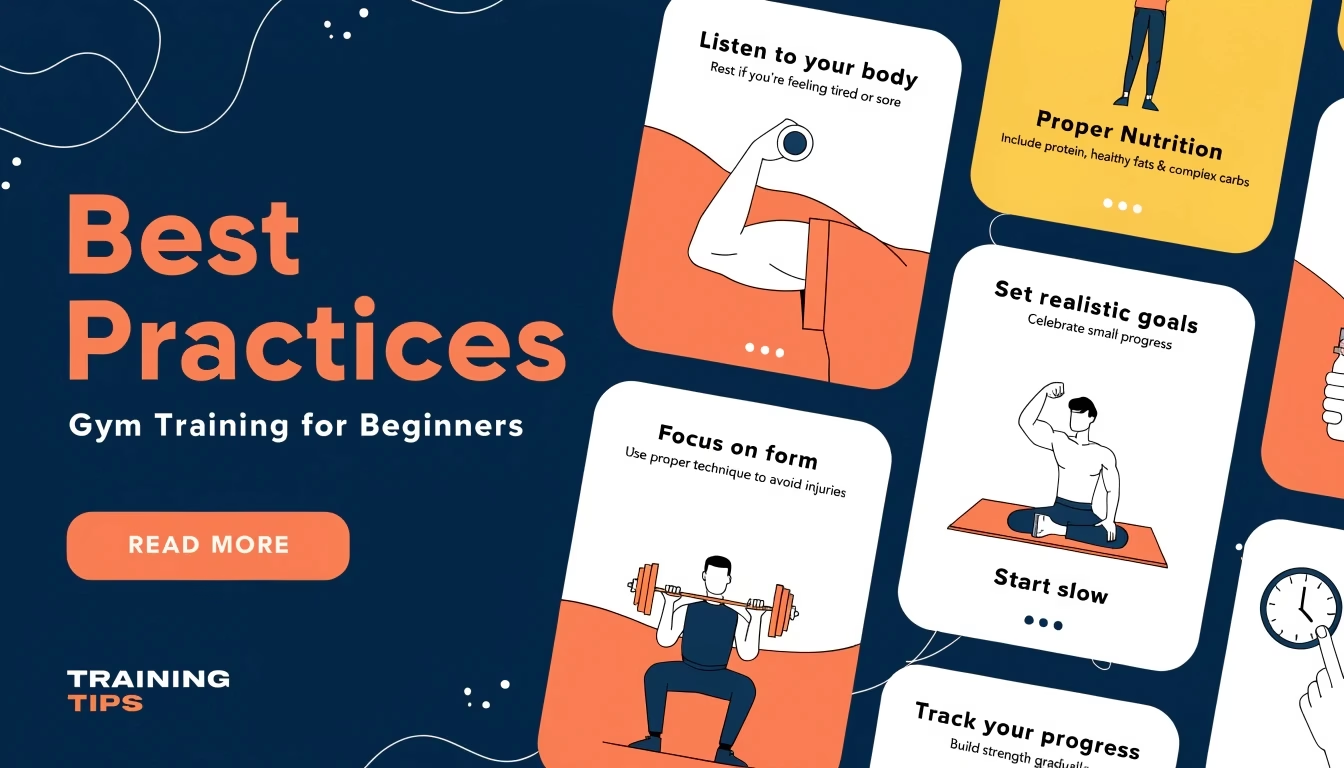
Before getting down to business, it’s important to first identify your motivation and your goal. Whether it’s focused on building muscle, losing weight, burning fat, cardiovascular training, or simply getting in shape, your goal must be achievable!
So the first thing you need to do is clearly define your goal. Trying to look like Arnold Schwarzenegger or any other fitness model—such as Lazar Angelov, Jeff Seid, or a Miss Bikini contestant—in six months is simply impossible.
A realistic goal is the best way to make progress in your training and stay motivated over the long term. In strength training, dedication and consistency are key to successfully sculpting the physique you want to achieve! For optimal progress, set yourself intermediate goals so you don’t get discouraged.
Choosing the right gym is also key to training under the best conditions. Here, you’ll find a selection of over 200 Fitness Park gyms across France and its overseas territories. To get off to the best start, it’s important to understand the big picture of a strength training session. We’ve broken down the ideal workout for you!
Gym Advice for Beginners: How Weight Training Works
How do you choose a workout routine without just jumping at the first program you find online? With so many resources available on the web, it’s easy to end up with a program that’s unsuitable for beginners to weight training. If your goal is to build muscle quickly, you should choose a full-body program so you can work every muscle group several times a week. We’ll go over this program in detail in this article.
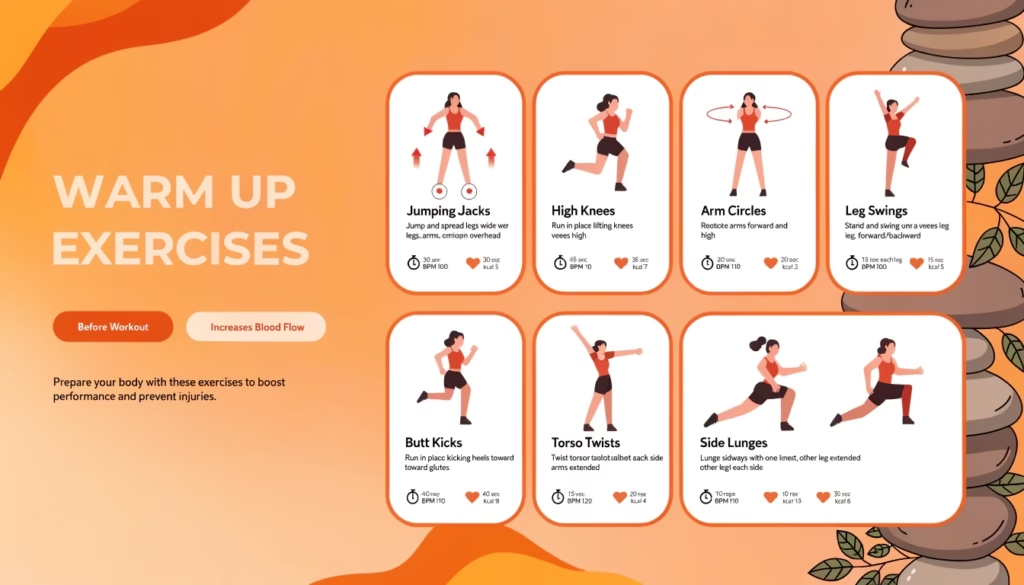
Each session begins with a program consisting of three phases:
–Warm-up
-Strength training
-Stretching
Gym Advice for Beginners: Warming Up Before Weight Training
The first phase is very important, as it will set the tone for your entire workout. Indeed, it is important not to neglect the warm-up; it serves to raise your body temperature, reduce the risk of injury, increase muscle performance, and prepare your cardiovascular system.
The warm-up should be gradual and last about 10–15 minutes. For an effective warm-up, we recommend starting with a few minutes on the rowing machine (about 4 to 5 minutes). This versatile exercise works all the major muscle groups in your body and improves your cardiovascular fitness. Our coaches can show you how to use the rowing machine properly—feel free to ask them for help!
Once your body has warmed up, you should now prepare the specific muscles that will be used during your strength training session. To do this, perform basic exercises with a low number of repetitions and minimal weight. For example, to warm up your chest muscles, you can do 15 to 20 push-ups, dips, or barbell bench presses with an empty bar.
The duration and frequency of strength training sessions for beginners
Now that you’re warmed up, you can start your strength training session based on your goals! An effective strength training session doesn’t have to last for hours—quite the opposite, in fact. The more time you spend training, the more exhausted you’ll become, and thus the less effective your workout will be. Allow between 45 minutes and 1 hour for the workout itself—that is, excluding the warm-up and stretching.
Your training frequency depends on many factors (work, availability, etc.), which is why 2 to 4 sessions per week are easy to incorporate into your schedule and also ensure proper recovery. When you’re just starting out with strength training, we recommend doing 3 sessions per week—on Monday, Wednesday, and Friday—to allow for some recovery time between sessions and give your muscles a chance to recover from the exertion.
You need to be in good shape to train, so don’t push yourself too hard. Trying to go too fast and overtraining is the surest way to stop making progress, lose motivation, and—most importantly—increase your risk of injury.
Stretching to Prevent Injuries

Just like warming up, stretching should not be overlooked. It aids recovery, can reduce muscle soreness, and helps maintain joint mobility. To help you stretch properly after your strength training session, we’ve written a dedicated article titled “Muscle Stretching: Why and When to Do It?” It will help you better understand the importance of stretching and its benefits for your progress in strength training.
Gym Advice for Beginners: Simple Weight Training Program
Let’s get right to the point, but do you still have questions? You’ve probably heard of different types of workouts, such as full-body, half-body, or split routines. Are these concepts still a bit unclear to you? We’ll explain the differences between these programs and which one every beginner should choose!
The Full-Body Program: This involves working out the entire body during each session (chest, triceps, legs, back, biceps, shoulders, etc.)
The Half-Body Program: This approach is divided into two parts. The first involves training the upper-body muscles (chest, back, biceps, triceps, shoulders), and the second focuses on the lower body (hamstrings, quadriceps, calves). Thus, you alternate between the two in each session—an upper-body session followed by a lower-body session, and so on.
The Split-Routine: This technique allows you to target a specific muscle group during each workout. For example, Monday is dedicated to the chest and triceps, Tuesday to the legs, Wednesday to the back and shoulders, and so on.
Each program can thus be assigned a skill level. For beginners, the Full-Body method is recommended; for intermediate exercisers, the Half-Body technique is optimal; and finally, for experts, the Split-Routine method is best.
The Full-Body Workout: A Great Way to Get Started with Weight Training
When you start weight training, it’s best to follow a full-body routine consisting of no more than 6 to 8 exercises. This type of routine works all the muscles in your body during a single session. The goal is to have you repeat each movement several times a week so that you perform them correctly and safely.
To do this, don’t hesitate to seek advice from a trainer first. By consistently training each muscle group, you’ll build strength, endurance, and stamina more quickly. Plus, since the training volume for each muscle group is higher, you’ll see faster progress and muscle growth. This is therefore the best approach for getting started with weight training.

Once you’ve gotten used to the full-body workout and want to continue making progress, you can switch to the half-body routine. This involves alternating between upper-body and lower-body workouts. The advantage is that you’ll be able to do more exercises per muscle group in the same amount of time.
Finally, it will be time for the split routine, which involves training specific muscle groups on different days throughout the week. The advantage of this approach is that it allows for a clear separation of the different muscle groups, enabling you to train them in an even more comprehensive and intensive manner.
Gym Advice for Beginners: Choosing exercises
To start with, opt for guided machines, which allow for safer, more precise movements. You can easily find these machines and dedicated areas (free weights, guided machines, cardio) to follow different types of workout programs at your Saint-Maur-des-Fossés gym. These machines ensure that you perform the movements perfectly and with control. This helps you avoid the risk of poor form and injury.
Focus on basic exercises such as the bench press (on a free bench if you’ve mastered the technique, on a machine, or on a guided frame), pull-ups (high pulley row), squats (leg press), and dips. These are known as multi-joint exercises, which have the advantage of working multiple muscle groups at the same time. A bench press works the chest muscles, as well as the arms and shoulders, unlike an isolation exercise such as the bench fly, which is specifically designed to target the chest muscles.
The number of sets, repetitions, and rest time
Always prioritize quality over quantity! You don’t need to do a large number of exercises, sets, or even repetitions. As we mentioned earlier in this article, we recommend doing 6 to 8 exercises during your workout. For effective progress, perform 2 to 3 exercises per muscle group, 3 to 4 sets, and between 8 and 15 repetitions.
Recovery times generally range from 30 seconds to 2 minutes. The more intense the workout, the longer the recovery period. For a program focused on building muscle mass, you should therefore prioritize high-intensity exercises with short sets and long rest periods.
Example: Bench press: 3 to 4 sets of 8 to 10 repetitions with a 2-minute rest between each set.
For a program focused on weight loss or muscle definition, you should therefore prioritize exercises with lower intensity, longer sets, and short rest periods.
Example: Bench press with 3 to 4 sets of 12 to 15 repetitions and 1 minute of rest between each set.
Gym Advice for Beginners: Strength Training Program for All
Now that you know how to train properly, here is a program to follow that will help you get off to an effective start with strength training and build muscle mass:
-Bench press (chest) – 4 sets of 12 reps – 1 minute 30 seconds rest
-Guided lat pulldown (back) – 3 sets of 12 reps – 1 minute 30 seconds rest
-Squats (legs) – 4 sets of 10 reps – 2 minutes rest
-Military press (shoulders) – 3 sets of 12 reps – 2-minute rest
-Machine-guided curl (biceps) – 4 sets of 12 reps – 1 minute 30 seconds rest
-Pulley triceps extension (triceps) – 4 sets of 10 reps – 1-minute rest

Our coach, Nassim Sahili, has also developed a beginner’s strength training program that includes a section specifically focused on nutrition and diet. You can read this article to learn more: Strength Training and Nutrition Program.
Are you interested in weight training but hesitant to take the plunge? Come meet us! We’ll guide you through your first session, explaining each piece of equipment and the proper form to use. You can also view our membership options and sign up directly online. All you’ll have to do is come to the gym and start your first workouts.
The key takeaway: don’t rush things. As the saying goes, “Good things come to those who wait,” and that’s what will allow you to progress safely. The second key word is “intensity.” An easy workout without intensity is ineffective and counterproductive; it will only cause you to plateau or even regress.
One last, crucial point: don’t neglect rest and recovery. Space out your workouts, and remember that your body repairs itself while you sleep.