


A traditional Chinese martial art, tai chi walking is a discipline that straddles the line between combat sport and gymnastics.
Renowned in China for its therapeutic benefits, numerous studies have examined the impact of this sport on the health of those who practice it. Let’s take a closer look at the medical literature…
INTRODUCTION TO TAI CHI WALKING (TAI JI QUAN) :
A branch of Chinese medicine :
The term Tai Ji Quan is composed of three characters, the first two of which literally mean “supreme ultimate” and encompass both the concepts of dynamic balance and the goal to be achieved.
The third character, Quan, means “fist” or “unarmed combat” and encompasses the martial arts dimension. The three characters can therefore be translated as “supreme combat” with an opponent or with oneself.
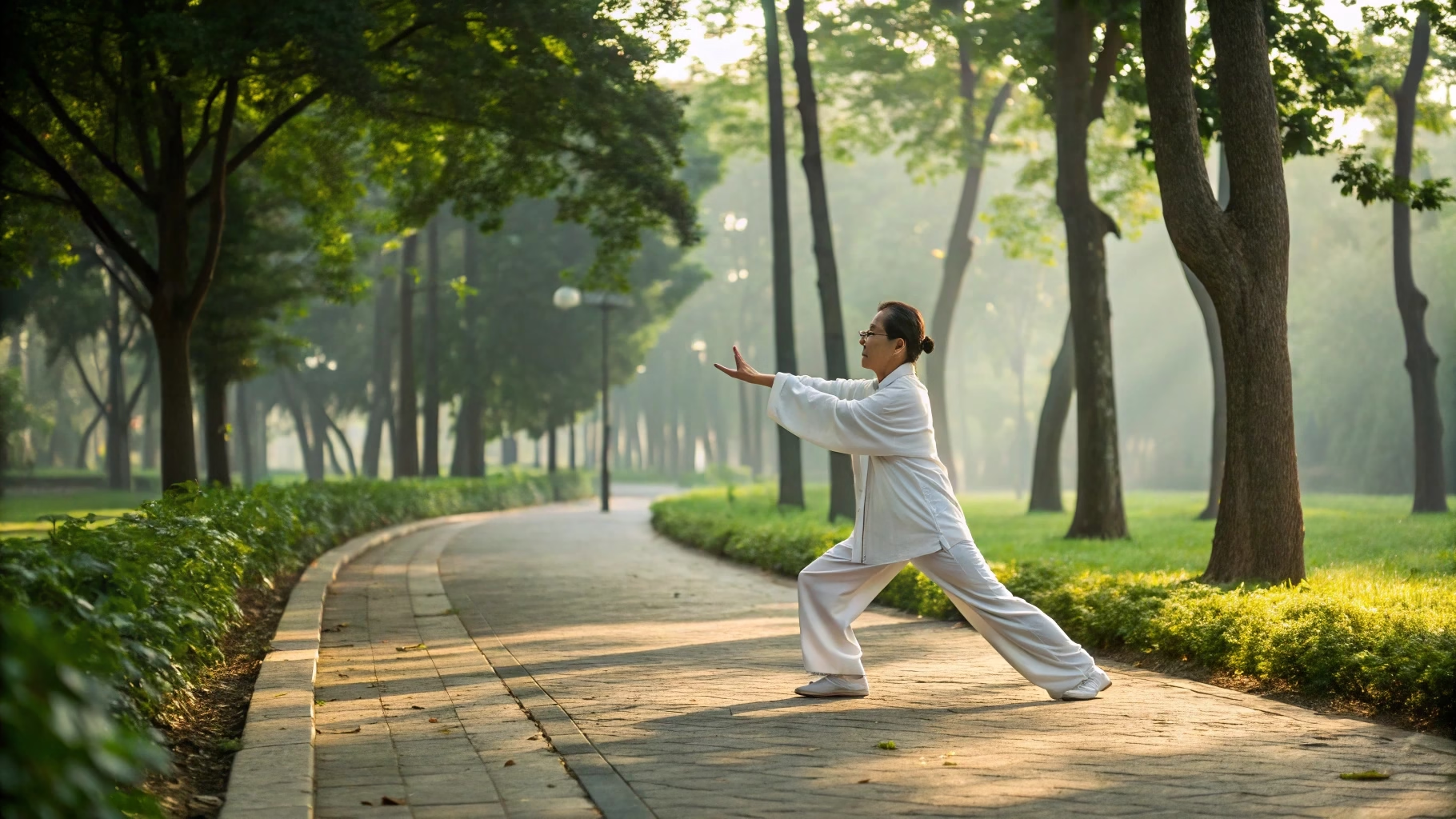
Derived from traditional martial arts, tai chi walking is a Chinese physical discipline involving a series of continuous, circular movements performed slowly and precisely in a pre-established order.
To fully understand what tai chi is, it is important to know that, along with qigong, it is one of the five branches of traditional Chinese medicine (energy exercises), the other four being acupuncture, dietetics, pharmacopoeia (medicinal herbs), and Tui Na massage.
It should be noted that Qi Qong differs from tai chi in that it involves shorter, isolated movements that can sometimes be performed while lying down, whereas tai chi is mainly practiced in an upright position.
A secret combat technique :
Over the centuries, Chinese society, regularly threatened by border and internal wars, developed a strong martial tradition. Tai chi walking was originally a combat technique for striking vital points, passed down orally from master to student in the utmost secrecy within peasant families.
A Chinese monk named Zhang Safeng, who lived in the 16th century, is said to have been inspired by a fight between a bird and a snake to devise the sequence of 13 basic tai chi postures.
The snake is said to have triumphed thanks to its slowness, flexibility, and rounded movements, which gave its opponent little to grab hold of.
From combat technique to gymnastics
Over the years, tai chi walking techniques have become much gentler. In 1976, when universities reopened in China, tai chi became accessible to the masses and was taught in physical education and university programs.
Today, millions of Chinese people practice tai chi every day, especially seniors, but many do so for reasons of inner development that go beyond simple physical training.
Tai chi is now considered a “holistic energy exercise” that emphasizes extreme precision of movement, breath control, and meditation. It aims to harmonize Qi (body energy) and improve flexibility, while strengthening the musculoskeletal system.
Learning to slow down in order to progress :
Tai chi cannot be learned in a flash… it requires perseverance, discipline, and dedication if you want to reap its benefits. The initial challenge for beginners is learning to slow down.
It is the extreme slowness of the movements that allows you to detect blockages and feel the flow of energy.
In addition, the awareness of the slow and precise transfer of body weight from one leg to the other and the alternating movement of the arms and legs perfectly embody the Chinese philosophy based on the dynamic balance of Yin and Yang forces.
During the sequences, it is the hands that guide the movements, capturing energy and transmitting it from one hand to the other so that the body finds its support in the Tan Tien, the center of gravity located below the navel.
The essence of tai chi lies in the search for the center of gravity, the balance between the two poles of energy, Yin, which comes from the earth, and Yang, which comes from the sky.
THERAPEUTIC APPLICATIONS : Tai Chi Walking For Seniors
Many studies report the benefits of practicing tai chi for various conditions. We found nearly 89 scientific articles (peer-reviewed journals) in the international literature since 1980.
None of these articles referenced on Medline come from French teams (validated by peer review). As expected, most of the experiments were carried out by American teams and even more so by Chinese teams or teams from other Asian countries.
Geriatricians were the first to take an interest in the therapeutic applications of tai chi. As early as 1982, a Chinese study suggested developing these practices, particularly traditional tai chi, to improve healthy aging and increase longevity.
The preventive aspects and the management of the balance between the individual and their environment, between the body and the psyche, are philosophical and practical aspects of Chinese tradition that are fully in line with the comprehensive and holistic approach of modern Western gerontology.
Reducing the risk of falls and improving balance in older adults
For older adults, “When you fall, it’s a fall! When you fall, it’s often the grave!” A fall can trigger a chain reaction leading to illness, disability, and even death.
Therefore, preventing falls has become a priority. Older adults generally enjoy moderate exercise, involving gentle but consistent movements that engage all parts of the body.
Tai chi walking is believed to help prevent falls because its movements incorporate elements of strength training, balance, postural alignment, and concentration.
Tai Chi Walking: Confusing results on fall prevention
Unfortunately, the results of numerous studies on tai chi and fall prevention are confusing and inconsistent.
While most experiments aimed to assess whether tai chi improved balance, only one study directly evaluated the link between tai chi and fall prevention.
Initially, this landmark study demonstrated, with great scientific rigor, the benefits of tai chi for elderly patients who were prone to falling but were not particularly frail. Statistical adjustment of the results showed that tai chi reduced the risk of recurrent falls by 47%.
However, the authors then qualified the results for patients in the process of becoming frail. To define this population (in the process of becoming frail), the team used 10 frailty criteria in recognized areas:
• age;
• balance;
• walking ability;
• other physical activities;
• level of depression;
• use of sedatives;
• near vision;
• pathological status;
• co-morbidities;
• upper and lower limb strength.
Based on these criteria, an elderly person is considered robust if 4 out of 10 items are strictly normal and if fewer than 2 items are severely impaired. Conversely, an elderly person is considered frail if 4 out of 10 criteria are severely impaired and only one criterion remains normal.
A trend analysis, taking into account intermediate assessment times, shows precisely that during the first month of learning, tai chi significantly increases the risk of falls in patients who are becoming frail.
It is only later, from the 4th to the 12th month, that tai chi significantly reduces the risk of falls in these same patients (47% in the tai chi group versus 60% in the other group).
These results, obtained in frail elderly people, are therefore less clear-cut than those obtained by the same team in patients who are not very frail or simply vulnerable.
Tai Chi Walking: Less loss of balance…
In addition, several randomized clinical studies have demonstrated the effectiveness of a tai chi program in preventing loss of balance in older adults. This is the most well-documented benefit of tai chi in scientific literature.
A comprehensive battery of validated tests in both motor skills and balance has shown that practicing tai chi improves balance more significantly than motor skills.
Tai chi walking is also particularly effective in restoring balance in older adults with visual and/or vestibular disorders.
The use of a statokinetic platform on subjects practicing tai chi showed a significant improvement in proprioceptive abilities in the knee, with an enlargement of the stability polygon in a standing position (in a dynamic static situation, combined with weight shifting).
The feeling of greater confidence among elderly people when moving around is also objectively demonstrated by the higher walking speed observed during the experiment among the group practicing tai chi walking.
A British study published in 2004 in the British Journal of Sport shows that tai chi promotes better kinesthetic proprioception in the ankle and knee joints, with tai chi being even more effective than jogging or swimming in preserving the kinesthetic threshold of the ankle joint.
This finding is essential, since we know that older people use more proprioceptive information from the hip to compensate for the weakening of kinesthetic information from the ankle or knee. However, the loss of ankle proprioception is largely responsible for the risk of falling.
An analysis of the literature on fall prevention through tai chi reveals a lack of standard measures for comparing the results of different studies.
While experiments show that tai chi walking can reduce the number of falls by up to 47%, most studies must be qualified by the protocols often used and the subsequent statistical analyses.
Three factors explain the variability in results.
• First, the duration of training varies greatly from one study to another. Long-term participation is likely to yield positive results. Indeed, across all the different studies, the benefits of tai chi increase steadily during the first three months and stabilize in the sixth month.
This seems to be the average time needed to learn the practice.
In addition, analysis of the various studies tends to show that tai chi is more beneficial to socially advantaged patients with higher levels of education.
Furthermore, an interventional practice to prevent falls is of little or no effectiveness in patients with significant cognitive deficits, or dementia or pre-dementia. Few studies take into account the cognitive status of practitioners.
• The second factor explaining the variability in the results of studies on fall prevention through tai chi is the variability in the styles of tai chi taught. It has been postulated that certain styles, such as Wu, may be more effective in improving balance (Hain, 1999).
However, this hypothesis has never been verified. Most studies use the popular Yang style, which may be more effective in strengthening leg muscles but less effective than the Wu style in terms of balance. In some studies, the style is not even specified.
• Finally, the age, gender, and health status (frailty) of participants are all factors that could affect the results, but they have sometimes not been evaluated.
Tai Chi Walking : Overall benefit?
Articles summarizing the benefits of tai chi in reducing the risk of falls and improving balance (8, 11) emphasize the need to improve the inclusion of older adults in order to create more homogeneous groups.
This harmonization of groups will make it possible, for example, to compare subjects from different age groups and social backgrounds, and to study the optimal duration and frequency of programs based on the health status of participants.
Furthermore, it would be particularly interesting to measure the number of falls directly, as improved balance may not be directly related to a reduction in falls.
As shown in the study by Wolf et al., initiated by the FICSIT program (The Atlanta Frailty and Injuries Cooperative Studies and Intervention Techniques), the results obtained on frail older adults tend to validate the need to adapt tai chi to the type of older adult and their level of frailty in order to better identify the most effective preventive measures.
It would be interesting for future studies to focus on subjects at risk of falling rather than on elderly people in “good health.”
Finally, the authors emphasize that the overall benefit of tai chi is proportional to the participants’ involvement and commitment.
The most beneficial effects are seen in people who are keen to continue the program, with an improvement in their quality of life and an interest in the cognitive stimulation provided by tai chi in relation to memorizing figures.
But what is the limit of cognitive deterioration beyond which tai chi is no longer effective?
It is worth considering a simplified form of tai chi that would allow people who do not have a high socio-cultural level or who have mild cognitive deficits to adhere more quickly and understand the philosophy of this art more easily.
Improving aerobic capacity
Published in 2004, a meta-analysis combined seven clinical studies involving 344 patients, examining the effect of tai chi on aerobic capacity.
The results indicate that individuals who regularly practice tai chi develop better aerobic capacity (peak VO2) than sedentary adults.
In addition, a preliminary clinical trial involving 30 subjects with chronic heart failure compared the effectiveness of a conventional rehabilitation technique with a tai chi program, in addition to usual care, over a 12-week period.
The results indicate a significant improvement in quality of life and aerobic capacity (peak VO2 and walking speed).
Improving quality of life

A systematic review of five clinical trials of varying quality showed that people who practice tai chi show significant improvements in several indicators of psychological well-being (depression, psychological distress, life satisfaction, perception of health).
The short-term effects of tai chi were evaluated in a pre/post-test program involving 11 elderly women. Not only did the study show an improvement in motor skills/balance, but also a significant improvement in anxiety levels, mood, and pain perception threshold.
The entire evaluation, which is well-argued, is based on criteria using validated scales or scores (goniometry, dynamometry, timed one-leg stand, tandem walk, depression and quality of life scale, analog pain scale).
Tai Chi Walking : Improving sleep
Sleep disorders in older adults often have serious and difficult-to-assess consequences, including increased morbidity and mortality from cardiovascular disease. Sleep disorders in older adults are frequently the result of benign, non-acute conditions (National Institute on Aging survey: Foley DJ et al, Sleep 1995).
The main causes include a gradual decline in physical activity and daily muscular exertion, anxiety, and depression.
In 2004, a clinical study compared the effect of tai chi with relaxation techniques (stretching and breath control) on sleep quality.
One hundred and sixteen people over the age of 60, suffering from moderate sleep disorders, participated three times a week for six months in one-hour sessions of tai chi or relaxation.
The authors demonstrated a significant improvement in sleep quality, both in terms of a reduction in the time taken to fall asleep (by 18 minutes on average) and an increase in sleep time (by 48 minutes on average), as well as a reduction in periods of daytime sleepiness.
At the same time, confirming the results of previous studies, tai chi also showed a clear improvement in physical performance tests of the lower limb muscles (single-leg stance, chair rise, fast walking). This improvement was significantly greater than that achieved with conventional low-intensity exercises.
Tai chi walking has thus proven to be an effective non-drug approach to treating sleep disorders in older adults. Engaging these patients in long, regular daytime physical activity has also improved motor function and muscle tone in the lower limbs.
Reducing certain symptoms of rheumatoid arthritis
In China, tai chi has been recognized for centuries as an effective treatment for rheumatoid arthritis.
According to four randomized controlled studies involving 206 participants, practicing tai chi can improve the range of motion in the lower limbs, particularly the ankles. They also emphasize that tai chi does not aggravate the symptoms of rheumatoid arthritis, which can occur during more intense exercise.
However, tai chi had no clinically significant impact on ease of daily activities, joint pain and swelling, or overall improvement as assessed by the patient.
Reducing osteoporosis
A randomized clinical trial indicates that tai chi reduces bone density loss in women who have been menopausal for at least 10 years.
However, the study does not allow the results to be applied to the Western population. Furthermore, it is unclear whether these results are specifically attributable to this martial art or to the effect of exercise in general.
Physical exercise from an early age helps to increase bone mineral density and reduces bone loss in adulthood.
Exercise not only improves bone quality, but also strengthens muscles, coordination, balance, flexibility, and overall health.
Walking, aerobics, and tai chi are particularly recommended for stimulating bone formation and strengthening supporting muscles. Encouraging physical exercise at all ages is therefore a top priority for preventing osteoporosis.
Relieving osteoarthritis
In 2003, a small randomized clinical trial was conducted with 43 women over the age of 55 suffering from osteoarthritis. They practiced tai chi weekly for twelve weeks or were assigned to a control group.
Significant positive changes were observed in the perception of pain, joint stiffness, balance, and abdominal muscle strength in the subjects practicing tai chi walking.
Preventing peripheral vascular accidents
A study was conducted on 10 elderly people who had been practicing tai chi for 10 years, compared with 10 elderly patients and 12 young sedentary subjects. Several tests were performed under baseline conditions and after pharmacologically induced vasodilation.
Measurements taken using laser Doppler recording show that tai chi is associated with a permanent and very significant increase in deep skin microcirculation, but above all with improved venous compliance and microarterial vasodilator response, resulting in improved physiological adaptability of circulation in the lower limbs.
Tai chi tends to bring the vascular parameters of older people who practice this activity regularly closer to those observed in young sedentary people.