



The best Nordic walking poles are the right length for your height (about your height x 0.68), light enough to swing all day, and fitted with a glove-style strap that lets you push off without gripping hard. This guide shows how to size, compare, and choose a pair of Nordic poles, then teaches the basic technique so you get the full-body benefit.
Nordic walking sticks are not the same as hiking poles. Trekking poles help you balance on rough trails; Nordic poles are designed to propel you forward on flat ground, so the strap, tip, and length all work differently.
Why Use Nordic Walking Poles?
Walking with Nordic poles turns an ordinary walk into a light full-body workout. Your arms, shoulders, upper back, and core join in, which raises your heart rate compared with walking at the same pace, and many walkers find the poles give them more stability and confidence. It is an easy way to reach the 150 weekly minutes of moderate activity recommended by the CDC physical activity guidelines. For more on the basics, see our guide to walking benefits and good practices.
If you have joint problems, balance issues, or a heart condition, consult your doctor before starting a new walking program.
How to Choose the Best Nordic Walking Poles
1. Pole Length: Height x 0.68
The standard formula is your body height multiplied by 0.68. When you hold the grip with the tip on the ground next to your foot, your elbow should bend at roughly 90 degrees. Beginners and people walking for comfort often round down; fitter walkers who take long strides can round up by 5 cm. Fixed poles usually come in 5 cm steps, so pick the nearest size.
| Your height | Recommended pole length |
|---|---|
| 5’0″ (152 cm) | 104 cm (41 in) |
| 5’2″ (157 cm) | 107 cm (42 in) |
| 5’4″ (163 cm) | 111 cm (44 in) |
| 5’6″ (168 cm) | 114 cm (45 in) |
| 5’8″ (173 cm) | 117 cm (46 in) |
| 5’10” (178 cm) | 121 cm (48 in) |
| 6’0″ (183 cm) | 124 cm (49 in) |
| 6’2″ (188 cm) | 128 cm (50 in) |
| 6’4″ (193 cm) | 131 cm (52 in) |
2. Adjustable vs Fixed-Length Poles
Fixed-length (one-piece) poles are lighter, quieter, and vibrate less because there is no joint. They suit regular walkers who know their size. Adjustable (telescopic) poles with a lever or twist lock let you fine-tune length, share poles in a household, or shorten them for travel. Folding poles collapse small enough for a suitcase. The trade-off is a little extra weight and a joint that needs checking.
3. Carbon vs Aluminum
Carbon-fiber shafts (look for a stated carbon percentage) are lighter and absorb more vibration, which your wrists and elbows will appreciate on long walks. Aluminum is heavier but tougher and more forgiving if you drop the pole on rocks. Fiberglass/carbon blends sit in between and are common on entry-level models.
4. Tips and Paws: Rubber vs Carbide
Most Nordic poles have a hard carbide (tungsten) tip for grip on grass, gravel, dirt, and ice. On pavement and indoor tracks you slip on an angled rubber paw (also called a boot or pad), which cushions the impact and stops the clacking. Check that replacement paws are easy to buy for your brand, because they wear out.
5. Straps and Gloves
The strap is what makes a Nordic pole a Nordic pole. A half-glove or glove-style strap lets you open your hand at the back of each stride and still control the pole. Detachable systems such as LEKI’s Shark/Trigger strap let you click your hand free without taking the strap off, which is handy for photos, water, or dog leashes. Make sure the strap fits snugly and does not rub the thumb.
6. Grips and Weight
Cork and cork-blend grips stay comfortable when your hands sweat; rubber or foam grips are durable and warm in cold weather. Lighter poles are easier on the shoulders, especially for seniors; most quality carbon poles weigh roughly 150–250 g each.
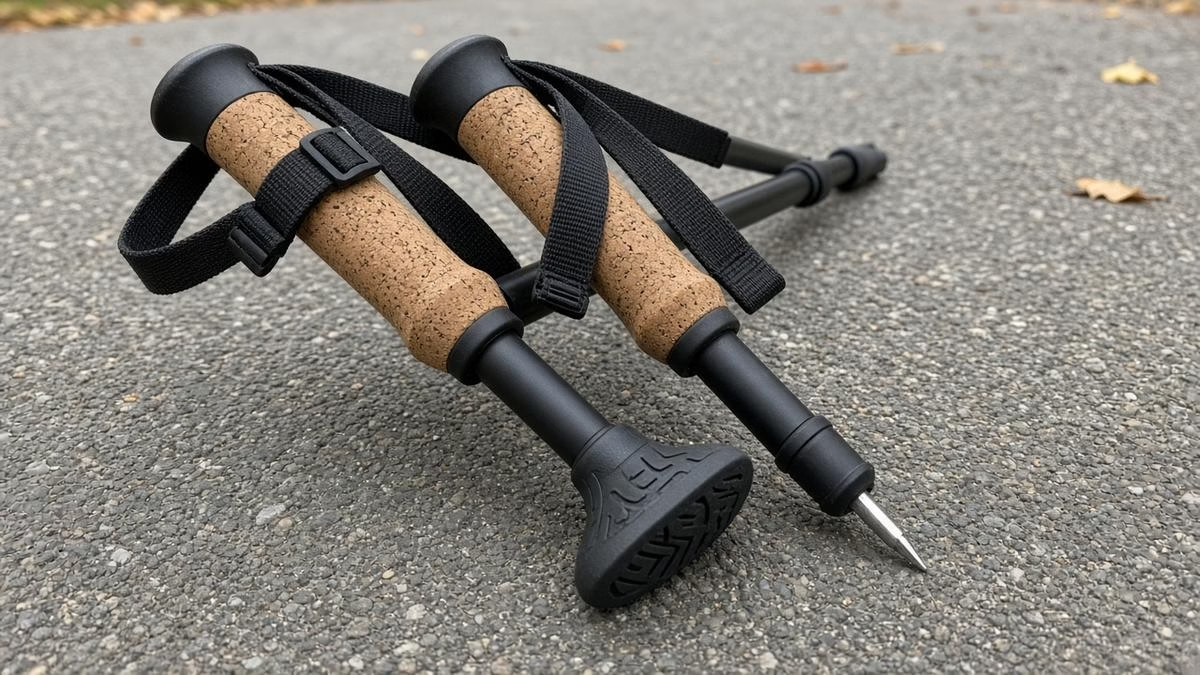
Nordic Poles Comparison: Which Features Suit You?
| Feature | Options | Who it suits |
|---|---|---|
| Length | Fixed / adjustable / folding | Fixed: regular walkers; adjustable: beginners, shared use; folding: travelers |
| Shaft | Carbon / aluminum / blend | Carbon: long walks, sensitive joints; aluminum: rough use, budget |
| Tip | Carbide + rubber paw | Carbide: trails, grass, ice; paw: pavement, sidewalks |
| Strap | Glove-style / detachable / simple loop | Glove or detachable: proper Nordic technique; loop: casual use |
| Grip | Cork / rubber / foam | Cork: sweaty hands, summer; rubber/foam: durability, cold weather |
| Weight | Under 200 g / 200 g+ per pole | Light: seniors, long distances; heavier: durability first |
Best Nordic Walking Poles: Brands Worth Knowing
Rather than chasing a single best model, choose from established brands that make dedicated Nordic walking poles with proper straps and replaceable paws. Prices change constantly, so compare current offers at specialist retailers.
- LEKI (Germany): the reference brand for Nordic walking. The Flash Carbon is a light fixed-length pole, and the Traveller Carbon is a folding model for trips. Both use LEKI’s detachable Shark strap system.
- Swix (Norway): cross-country ski specialist with fixed and adjustable Nordic walking poles.
- Exel (Finland): pioneered dedicated Nordic walking poles; known for high-carbon fixed shafts.
- Gabel (Italy): wide range of adjustable and fixed poles with comfortable straps.
- Komperdell (Austria): sturdy adjustable and carbon models.
- TSL (France): the Tactil range adds a simple, comfortable strap system.
- Guidetti (Italy) and Newfeel by Decathlon: solid choices for beginners who want a first pair.
How to Use Nordic Poles for Walking: Technique Basics
Good technique is what turns walking Nordic poles into a workout. Practice on a flat path first.
Step 1: Set Up and Walk Naturally
- Starting position: Strap in, stand tall, and let the poles hang loosely, dragging behind you as you walk.
- Movement: Walk normally for 1–2 minutes and let your arms swing in opposition to your legs (right arm with left leg).
- Sets x reps: 2–3 minutes as a warm-up at the start of every walk.
- Common mistake: Swinging the same arm as the same leg (“camel walk”).
- Easier / harder: Easier: Hold the poles in the middle and simply walk. Harder: Lengthen your stride while keeping the drag smooth.
Step 2: Plant the Pole
- Starting position: Arms relaxed, poles angled backward, tips behind your front foot.
- Movement: As your heel strikes, plant the opposite pole roughly level with your other foot, tip pointing back.
- Sets x reps: Practice 5 minutes, focusing on the rhythm.
- Common mistake: Planting the pole in front of your body like a hiking pole, which brakes you.
- Easier / harder: Easier: Shorten your stride and slow down. Harder: Increase pace while keeping the angle backward.
Step 3: Push and Release
- Starting position: Pole planted, hand gripping lightly.
- Movement: Push down and back through the strap, extend your arm past your hip, then open your hand and let the strap carry the pole forward.
- Sets x reps: 10–20 minutes of continuous Nordic walking.
- Common mistake: Gripping tightly the whole time, which tires your forearms.
- Easier / harder: Easier: Push gently and keep a shorter arm swing. Harder: Push harder and walk up gentle hills.
Step 4: Posture and Core
- Starting position: Head up, eyes forward, shoulders down and relaxed.
- Movement: Lean very slightly forward from the ankles and rotate your torso gently with each stride.
- Sets x reps: Check your posture every few minutes during the walk.
- Common mistake: Hunching over the poles or looking at your feet.
- Easier / harder: Easier: Walk slower and focus only on standing tall. Harder: Add intervals: 1 minute fast, 2 minutes easy.
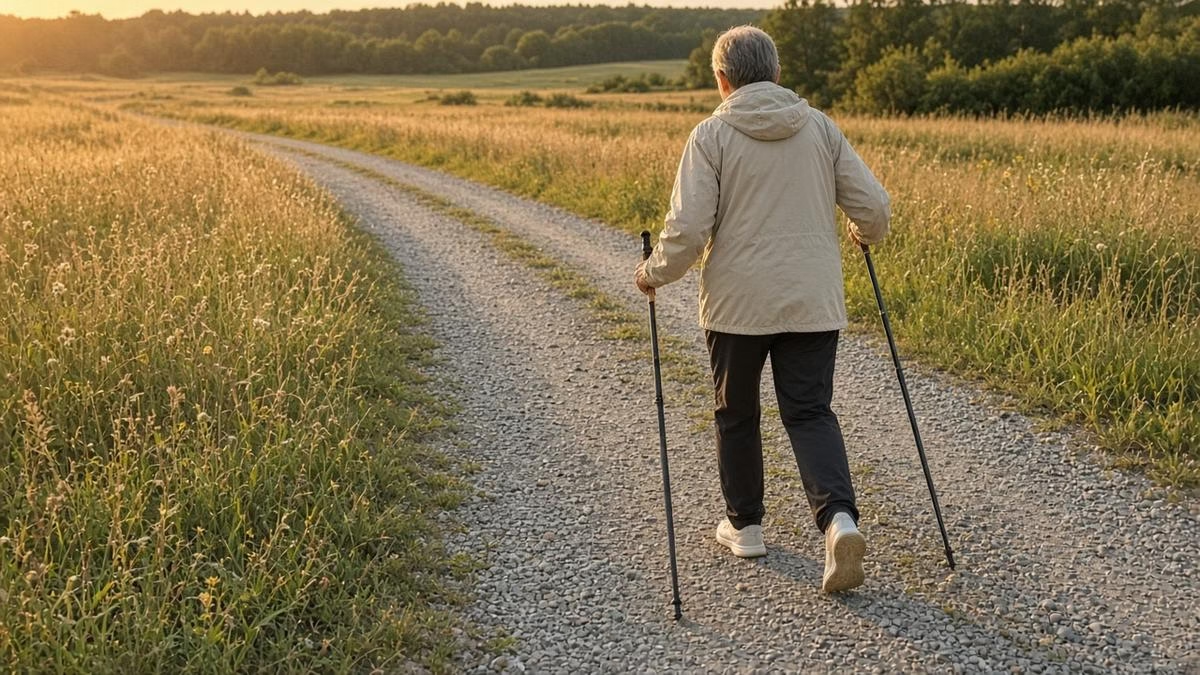
Getting Started: A Simple Plan
Start with three 20-minute walks per week, then add 5 minutes per week until you reach 45 minutes. Want to know how far that gets you? Our article on how many steps to lose a pound puts walking volume in perspective, and seniors can find other ideas in the best physical activities for seniors.
Care and Maintenance
- Rinse mud and sand from tips and locking parts after wet walks.
- Dry adjustable poles fully extended so the joints do not corrode.
- Replace rubber paws when the angled sole wears flat.
- Check carbide tips; dull tips slip on ice.
FAQ
What length should Nordic walking poles be?
Multiply your height by 0.68. A 5’6″ (168 cm) walker needs about 115 cm. With the tip on the ground beside your foot, your elbow should bend near 90 degrees.
What are the best Nordic walking poles for beginners?
An adjustable or fixed carbon-blend pole with a glove-style strap and rubber paws, from a dedicated brand such as LEKI, Swix, Exel, Gabel, or Komperdell.
Are Nordic walking sticks the same as hiking poles?
No. Hiking poles are for balance on rough terrain. Nordic poles have glove-style straps and angled tips to propel you forward on flatter ground.
Carbon or aluminum Nordic poles: which is better?
Carbon is lighter and absorbs vibration, better for long walks and sensitive joints. Aluminum is heavier but more durable and usually cheaper.
Do I need rubber tips on Nordic poles for walking on pavement?
Yes. Rubber paws grip asphalt, cushion each plant, and reduce noise. Remove them on grass, gravel, or snow to use the carbide tip.

