



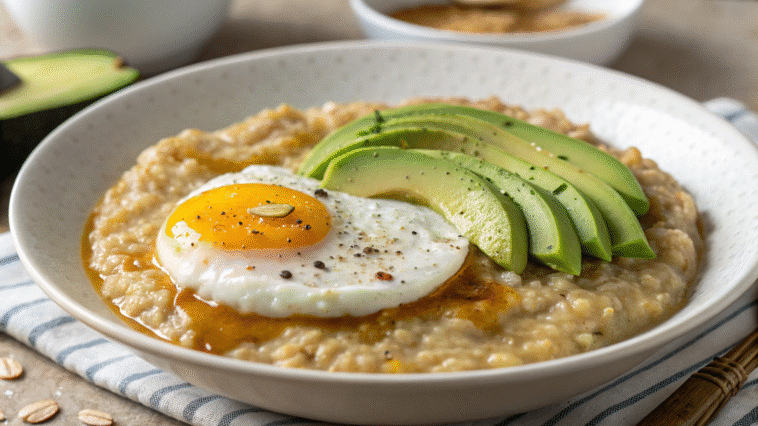
A high-protein breakfast for weight loss is not a special food. It is a breakfast with a clear protein anchor, a calorie number you can actually count, and a method you will still follow on a Wednesday. This page is the map for the breakfast recipes on A to Z Fitness: twelve options with calories, protein, and time in one table, then the same recipes sorted by the problem you are trying to solve. Every number is an estimate scaled from USDA FoodData Central and rounded. This is general cooking information, not medical advice. See the disclaimer.
Nothing here promises that a breakfast causes weight loss. Weight change depends on the whole day and the whole week. What a well-built breakfast does is make one meal predictable, so the rest of the day is easier to plan around. If you want the browsable list instead of the guide, the category page is High-Protein Breakfast.
How much protein at breakfast, and how many calories
Start with your daily protein target, not with the breakfast. The site’s guide to how much protein to eat to lose weight explains how to set that number. Once you have it, breakfast is simple division. If your target is around 100 to 120 g a day and you eat three meals and one snack, each meal lands somewhere around 25 to 35 g. That is why every recipe in the table below sits between 23 and 37 g of protein. It is arithmetic, not a magic threshold.
Calories work the same way. The breakfasts on this site run from about 206 to 380 kcal at the weights written. That range leaves room for lunch, dinner, and a snack inside most calorie targets people use when they are trying to lose weight, but it is a range, not a prescription. A 380 kcal breakfast is not “worse” than a 210 kcal one. It is a larger meal, and the rest of your day has to know about it.
Two numbers are worth reading together:
- Protein per serving, to see whether breakfast pulls its share of the daily target.
- Protein per 100 kcal, to see how much of the calorie budget the protein costs. A turkey and yogurt box gets about 18 g of protein per 100 kcal. Overnight oats get about 6 g. Both are useful. They do different jobs.
Twelve high-protein breakfasts, compared
Sorted by protein per 100 kcal, highest first. Calories and protein are the rounded estimates printed on each recipe page. Time is hands-on time for one serving unless the row says otherwise. Each name links to the page that owns the recipe, the full ingredient weights, and the USDA table.
| Breakfast | kcal | Protein (g) | Protein per 100 kcal (g) | Time | Recipe page |
|---|---|---|---|---|---|
| Savory yogurt and turkey box | 206 | 37 | 18.0 | 8 min | Greek yogurt breakfast meal prep |
| Turkey breakfast toast | 229 | 30 | 13.1 | 5 min | Breakfasts under 400 calories |
| Five-minute egg-white plate | 219 | 27 | 12.3 | 7 min | Breakfast for busy mornings |
| Yogurt egg muffins | 212 | 26 | 12.3 | 32 min, batch | Greek yogurt breakfast meal prep |
| Raspberry almond yogurt bowl | 276 | 29 | 10.5 | 5 min | Breakfasts under 400 calories |
| Berry cottage cheese bowl | 222 | 23 | 10.4 | 5 min | Cottage cheese recipes for weight loss |
| Yogurt berry chia jar | 235 | 24 | 10.2 | 5 min | Greek yogurt breakfast meal prep |
| Freezer turkey breakfast wrap | 358 | 35 | 9.8 | 15 min ahead, reheat from frozen | Breakfast for busy mornings |
| Microwave egg and yogurt mug | 257 | 24 | 9.3 | 5 min | Breakfast for busy mornings |
| Banana oat yogurt cup | 268 | 23 | 8.6 | 5 min | Greek yogurt breakfast meal prep |
| Black bean egg skillet | 366 | 30 | 8.2 | 12 min | Breakfasts under 400 calories |
| Blueberry Greek yogurt overnight oats | about 380 | 23 | 6.1 | 5 min + overnight | High-protein overnight oats |
Protein per 100 kcal is calculated here from the rounded summary numbers, so it is a guide for comparing rows, not a lab figure. The overnight oats page rounds calories to the nearest 5 kcal, which is why that row says “about.” None of the twelve use protein powder.
The table is deliberately not a ranking of “best” breakfasts. The oats row sits last on protein density and first on comfort for a lot of people. A breakfast that is slightly less efficient on paper and that you actually eat every morning beats a turkey box you abandon by Thursday.
How the numbers on these pages are made
Every recipe on this site that carries a calorie line follows the same method. Weigh each ingredient, divide by 100, multiply by the USDA FoodData Central value per 100 g, add the rows, then round to the nearest kilocalorie and the nearest gram. The USDA entry is named on each recipe page by its FDC ID, so you can check it.
Three rules keep the numbers honest:
- Oil is counted only when it is in the recipe. Five grams of olive oil is about 44 kcal (FDC 171413). If you add oil that the recipe does not list, add it to the total.
- Plain foods only. The yogurt is plain nonfat Greek yogurt (FDC 330137), and the turkey is plain roasted breast meat (FDC 171496). Flavored yogurt and brined deli turkey are different foods.
- Your package label wins. If your label disagrees with the USDA row, your label describes what you bought.
Pick a breakfast by what you need
Most people do not search for “a breakfast.” They search for a breakfast that fits a constraint: a calorie cap, a Sunday prep session, ten minutes before leaving, or no protein powder in the house. Each constraint has a page.
Under 400 calories
All twelve breakfasts in the table land under 400 kcal at the written weights. The page built specifically for this cap is high-protein breakfasts under 400 calories: a black bean egg skillet (366 kcal, 30 g protein), turkey toast (229 kcal, 30 g), and a raspberry almond yogurt bowl (276 kcal, 29 g). That page also explains what breaks the cap: a second spoon of honey, a “handful” of almonds instead of 10 g, a latte that nobody counted.
If you want the lowest-calorie options with at least 25 g of protein, look at the turkey and yogurt box (206 kcal), the egg muffins (212 kcal), and the egg-white plate (219 kcal).
Meal prep
If you can give breakfast one session a week, Greek yogurt breakfast meal prep covers four make-ahead options from one shopping list: berry chia jars, savory turkey boxes, banana oat cups, and baked egg muffins. Jars, boxes, and muffins keep up to three days in the refrigerator in that plan. The muffins also freeze.
Two other make-ahead breakfasts live on their own pages. The high-protein overnight oats are a night-before jar. The freezer turkey wrap on the busy-mornings page is cooked once and reheated from frozen. For a prep session that also covers lunches, use the high-protein meal prep guide.
Busy mornings
High-protein breakfast for busy mornings is for the morning you did not prep. It has a freezer turkey wrap (358 kcal, 35 g), a five-minute egg-white plate (219 kcal, 27 g), and a one-mug microwave breakfast (257 kcal, 24 g). The useful idea on that page is that the time that matters is hands-on time when you are already dressed, not the cook time printed on a recipe card.
No-cook options also count as busy-morning breakfasts: the turkey toast, the raspberry yogurt bowl, and the berry cottage cheese bowl are assembly only.
No protein powder
Every breakfast in the table gets its protein from ordinary food: Greek yogurt, eggs and egg whites, cottage cheese, roasted turkey breast, beans, and a little from oats, chia, and almonds. You do not need a scoop to reach 25 to 35 g at breakfast.
The overnight oats page does include one protein powder version (about 445 kcal and 37 g protein, using a typical label). It is an option, not the base. The blueberry base on that page reaches about 23 g without powder, and the strawberry cheesecake version with cottage cheese is listed there at about 355 kcal and 27 g. If you add a scoop to any recipe on this site, use the scoop’s own label and stop quoting the printed total.
Build your own high-protein breakfast
The recipes are examples. Once you see the pattern, you can build a breakfast from what is in your fridge and still estimate it. Start with one protein anchor, add a carbohydrate or fruit you enjoy, then be careful with the small, dense extras.
Protein anchors (per 100 g, USDA)
| Food | FDC ID | kcal | Protein (g) | Protein per 100 kcal (g) |
|---|---|---|---|---|
| Turkey breast, roasted, meat only | 171496 | 147 | 30.1 | 20.5 |
| Egg white, raw | 172183 | 52 | 10.9 | 21.0 |
| Greek yogurt, plain, nonfat | 330137 | 61 | 10.3 | 16.9 |
| Cottage cheese, lowfat, 2% milkfat | 328841 | 84 | 11.0 | 13.1 |
| Egg, whole, raw | 171287 | 143 | 12.6 | 8.8 |
| Black beans, cooked, without salt | 173735 | 132 | 8.9 | 6.7 |
Two hundred grams of plain nonfat Greek yogurt is about 122 kcal and 21 g protein. Add 100 g of egg white to one whole egg (50 g) and you have about 124 kcal and 17 g of protein before anything else goes in the pan. Those two combinations are the backbone of most recipes in the table.
Dense extras to weigh, not pour
| Food | FDC ID | kcal per 100 g | A typical add-on |
|---|---|---|---|
| Olive oil | 171413 | 884 | 5 g ≈ 44 kcal |
| Almonds | 170567 | 579 | 10 g ≈ 58 kcal |
| Chia seeds, dried | 170554 | 486 | 15 g ≈ 73 kcal |
| Whole-wheat tortilla | 174081 | 310 | 50 g ≈ 155 kcal |
| Honey | 169640 | 304 | 8 g ≈ 24 kcal |
None of these are “bad.” They are where a 250 kcal breakfast quietly becomes a 450 kcal one. Weigh them the first few times, learn what the right amount looks like in your spoon, then eyeball with that picture in mind.
A simple week of breakfasts
Rotation keeps breakfast from turning into one food every day, and it spreads the prep. One workable pattern:
- Sunday: make four yogurt berry jars or turkey boxes, and four freezer wraps if you have a busy week ahead. Eat the black bean egg skillet while things cool.
- Monday and Tuesday: a prepped jar or box from the fridge.
- Wednesday: turkey toast or the egg-white plate, whichever needs less washing up.
- Thursday: a freezer wrap, reheated.
- Friday: overnight oats, made Thursday night.
- Saturday: the berry cottage cheese bowl or a cottage cheese egg scramble from the cottage cheese recipes page.
Across that week, breakfast protein stays between about 23 and 37 g and calories stay under 400 every day, using each recipe page’s own estimate. For lunches and dinners that fit around these breakfasts, use the 7-day high-protein meal plan.
Mistakes that make a good breakfast stop working
- Counting the recipe, eating something else. A 70 g tortilla is not the 50 g tortilla in the wrap. A flavored yogurt is not plain nonfat. The number belongs to the weights on the page.
- Adding the breakfast to a second breakfast. A post-workout snack on top of the wrap is two meals. Count both, or move the breakfast after training.
- Forgetting the drink. Black coffee and plain tea are not in any table. Milk, juice, and sugar in the cup are extra.
- Choosing only by protein density. The turkey box is the most efficient row, but if you do not like it, the oats you will actually eat are the better plan.
- Treating breakfast as the whole strategy. A 220 kcal breakfast followed by an uncounted afternoon does not add up to a plan. Breakfast is one meal out of the day.
FAQ
How much protein should a breakfast for weight loss have?
There is no single number for everyone. A practical way to choose is to divide your daily protein target by the number of meals you eat. For many people that lands breakfast around 25 to 35 g. Every breakfast in the table above sits between 23 and 37 g. To set the daily target, read how much protein to lose weight.
How many calories should a high-protein breakfast be?
This page does not set a personal calorie target. The breakfasts here range from about 206 to 380 kcal at the written weights, which leaves room for the rest of the day in most plans. Whether 250 or 380 kcal is right for you depends on your daily total and how you split it.
Can I have a high-protein breakfast without eggs?
Yes. The turkey and yogurt box (206 kcal, 37 g protein), the turkey toast (229 kcal, 30 g), the raspberry yogurt bowl (276 kcal, 29 g), the berry chia jar, the banana oat cup, the berry cottage cheese bowl, and the overnight oats contain no egg.
Do I need protein powder to reach 25 to 30 g of protein at breakfast?
No. None of the twelve breakfasts in the table use protein powder. Greek yogurt, egg whites, cottage cheese, and roasted turkey breast do most of the work. Powder is an option on the overnight oats page, not a requirement.
Is it better to skip breakfast if I am trying to lose weight?
This page does not recommend skipping or not skipping. Some people prefer to eat later in the morning, and that is a scheduling choice. If you do eat breakfast, a counted, protein-anchored meal like the ones above makes the rest of the day easier to plan. If you have a medical condition that affects how you eat, follow your clinician’s advice.
Sources
USDA FoodData Central, read 8 October 2026. Energy is kilocalories (nutrient 208). Values per 100 g. Recipe totals come from the individual recipe pages linked in the table.
- FDC 171496, turkey breast, meat only, roasted: 147 kcal, 30.13 g protein.
- FDC 172183, egg white, raw: 52 kcal, 10.9 g protein.
- FDC 330137, Greek yogurt, plain, nonfat: 61 kcal, 10.3 g protein.
- FDC 328841, cottage cheese, lowfat, 2% milkfat: 84 kcal, 11.0 g protein.
- FDC 171287, egg, whole, raw: 143 kcal, 12.56 g protein.
- FDC 173735, black beans, cooked, boiled, without salt: 132 kcal, 8.86 g protein.
- FDC 171413, olive oil: 884 kcal. FDC 170567, almonds: 579 kcal. FDC 170554, chia seeds, dried: 486 kcal. FDC 174081, whole-wheat tortilla: 310 kcal. FDC 169640, honey: 304 kcal.
Database: https://fdc.nal.usda.gov/