




In short: every calorie and protein figure on this site is calculated, not estimated. We weigh ingredients, look each one up in USDA FoodData Central by its FDC ID, add the rows, and round at the end. Each recipe names the USDA entries it used so you can check us. This page explains the whole method, including where the numbers are weak.
It exists for one reason: a number you cannot check is a number you should not trust. If you find a figure here that does not survive this method, write to us and we will change it.
Who does the work, and what we do not claim
A to Z Fitness is written by a small editorial team. Recipes and guides carry the byline Jake Morrison, which is a pen name for that team rather than a single individual, and the avatar shown with it is an illustration, not a photograph.
We are recipe writers and researchers, not clinicians. Our team does not include doctors, registered dietitians or certified personal trainers, and we do not publish anything that pretends otherwise: no invented credentials, no stock photo passed off as an author, no review by a professional who does not exist. Where a page touches on medication or a medical condition, it says plainly that it is general information and points you to your own clinician.
What we do instead is make the arithmetic auditable. That is a narrower claim than a dietitian’s sign-off, and it is one we can actually keep on every page.
How a calorie or protein number is made
Every recipe on this site that carries a nutrition line follows the same five steps.
- Weigh the ingredient. The quantity in the recipe is the weight we calculated with, in grams, not a cup estimate for anything dense.
- Divide by 100 to get a multiplier for the USDA value, which is published per 100 g.
- Multiply by the USDA FoodData Central value for that exact food: plain nonfat Greek yogurt is FDC 330137, roasted turkey breast meat is FDC 171496, olive oil is FDC 171413. The FDC ID is named in the table on the recipe page.
- Add the rows across every ingredient the recipe counts.
- Round once, at the end: to the nearest gram and the nearest kilocalorie. Rounding is never applied per ingredient, because five rounded numbers do not add up to a correct total.
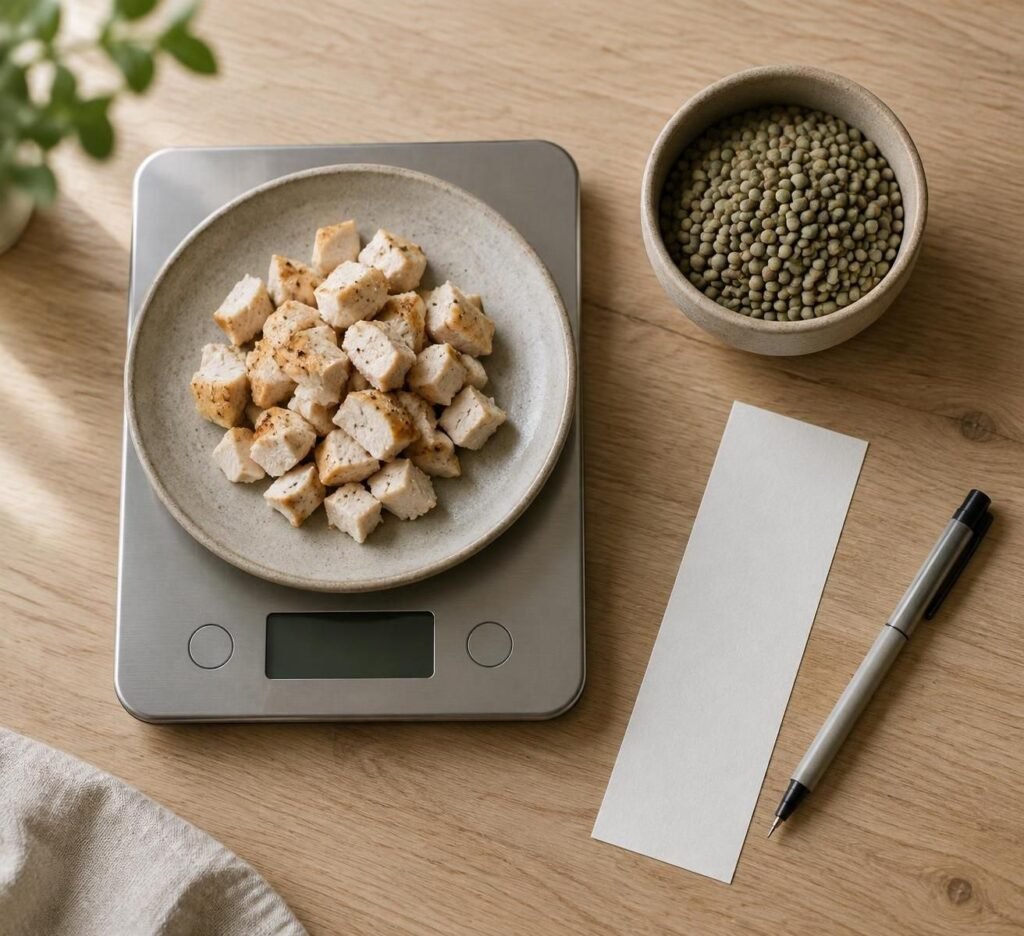
The same method produces the reference tables on the protein per 100 g chart, where a second column, protein per 100 calories, is simply protein grams divided by calories per 100 g and multiplied by 100.
What counts, and what does not
Consistency matters more than completeness here. These are the rules we apply to every recipe, and the reason some totals will differ from another site’s version of the same dish.
| Item | Rule | Why |
|---|---|---|
| Oil | Counted when it is listed in the method | Five grams of olive oil is about 44 kcal. If you add oil that the recipe does not list, add it to the total yourself |
| Salt added in cooking | Not counted when the main ingredients are already salty | Salt carries no calories; the sodium line would only mislead |
| Pepper, lemon, vinegar, garlic, dried spices | Left out of the totals | Negligible calories, and quantities vary too much to be meaningful |
| Flavored or brined products | Not substituted for plain ones | Brined deli turkey and flavored yogurt are different foods from the plain USDA rows, with different numbers |
| Your packaging | Wins over USDA when the two disagree | Your label describes the product you actually bought |
| Raw versus cooked weight | Each recipe states which one it means | Cooking drives off water, not protein: 4 oz raw chicken is about 25 g of protein, and the same 4 oz weighed cooked is about 35 g |
Where the numbers are weaker, and we say so
Three honest limits, because a method page that claims perfection is advertising rather than a method.
Brands move. Tofu, bread, protein powder and protein pasta vary more between brands than any other food we use. Extra-firm tofu ranges from about 8 g to 15 g of protein per 100 g depending on the block. Where a brand matters, we say so and tell you to read the panel.
USDA values are averages. A chicken breast is not a laboratory sample. The FDC entry is a population average, and your particular piece of meat is somewhere around it. Expect a few percent of drift on any single ingredient.
Cooking losses are not modelled. We do not attempt to account for fat rendering out of meat or for moisture gain in rice. The ingredient weights in the recipe are the weights we used, and the total is the sum of those ingredients as written.
How we use AI tools
AI tools help with drafting, editing, and formatting tables. They are not the source of any nutrition figure: every number is calculated from USDA data as described above, and the FDC IDs are published so the calculation can be reproduced without us.
We also use AI for the interactive tools on the site, such as the protein calculator and Recipe Lab. Those tools apply the same formulas described on this page to the numbers you enter. They are calculators, not advice.
How mistakes get fixed
If a figure is wrong, we correct the page and note that it was changed. Corrections are not quietly overwritten: the goal is that a reader who spotted the error can see it was acted on. If you find something that does not hold up, the fastest route is the contact page, and the fuller statement of how we work is in our editorial policy. What we are responsible for, and what we are not, is set out in the disclaimer.
Why this matters more than a byline
Nutrition content online is full of numbers with no visible origin, copied between sites until nobody remembers where they started. A page that names its USDA entries, states its rounding rule and admits where the method is weak can be checked in a few minutes by anyone with a browser. That checkability is the thing we can offer without claiming qualifications we do not have, and it is the reason this page exists.
Sources
Every number on this page traces back to one of these, and all of them are public:
- USDA FoodData Central: the database every calorie and protein figure is calculated from.
- National Academies, Dietary Reference Intakes for Protein and Amino Acids: the reference values behind the protein guidance.
Where a figure here disagrees with the source, the source wins and we correct the page: the full worked method, including its limits, is on how the numbers on this site are made.