


Quick answer: For weight loss on a walking pad, start with 15 to 20 minutes a day at an easy 2.0 to 2.5 mph (3.2 to 4.0 km/h), then build over 4 weeks to 30 to 45 minutes most days, with short brisk intervals at 3.0 to 3.5 mph (4.8 to 5.6 km/h). A 180 lb (82 kg) person burns roughly 115 to 175 calories per 30 minutes depending on speed. Walking works best for weight loss when it is paired with a modest calorie deficit and enough protein.
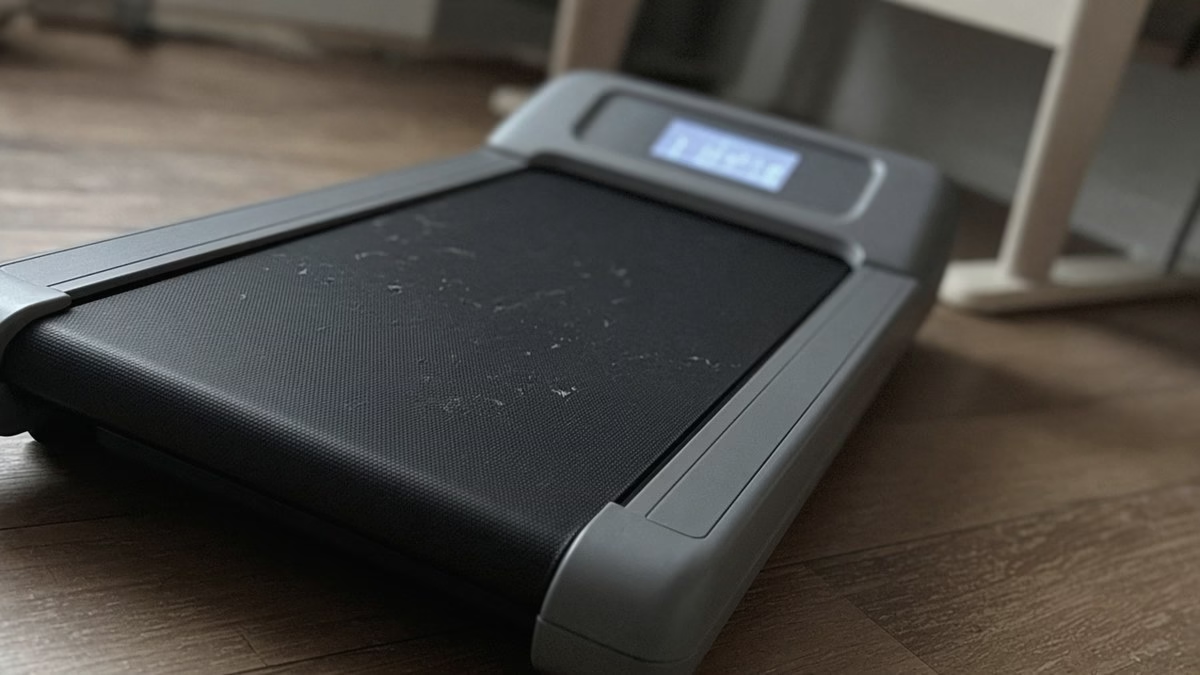
A walking pad is a flat, compact treadmill that slides under a desk or a couch. Most models have no incline and a top speed around 3.5 to 4 mph (5.6 to 6.4 km/h), so the workouts are different from a regular treadmill: you win with time and consistency, not intensity. This plan is built for that.
What’s in this guide
- How many calories does a walking pad burn?
- How much should you walk to lose weight?
- The 4-week walking pad plan
- 3 walking pad workouts with no incline
- Walking pad at your desk: what works
- Safety and setup basics
- Eat to support the walking
- FAQ
- The bottom line
HOW MANY CALORIES DOES A WALKING PAD BURN?
Estimated calories for 30 minutes, calculated with MET values from the Compendium of Physical Activities (calories = MET × body weight in kg × hours). Real numbers vary with your fitness, stride and handrail use.
| Speed | Effort | 150 lb (68 kg) | 180 lb (82 kg) | 210 lb (95 kg) |
|---|---|---|---|---|
| 2.0 mph (3.2 km/h) | Easy, desk pace | 95 | 115 | 135 |
| 2.5 mph (4.0 km/h) | Comfortable | 100 | 125 | 140 |
| 3.0 mph (4.8 km/h) | Moderate | 120 | 145 | 165 |
| 3.5 mph (5.6 km/h) | Brisk | 145 | 175 | 205 |
These are gross calories, which include what your body would burn at rest anyway. The real value of a walking pad is volume: 60 extra minutes at an easy 2.0 to 2.5 mph (3.2 to 4.0 km/h) spread across a workday adds roughly 190 to 280 calories for most adults between 150 and 210 lb (68 and 95 kg) without feeling like a workout.
HOW MUCH SHOULD YOU WALK TO LOSE WEIGHT?
- The CDC’s baseline for adults is at least 150 minutes of moderate activity a week, such as brisk walking, plus 2 days of muscle strengthening.
- For weight loss, the American College of Sports Medicine notes that more is usually needed: about 150 to 250 minutes a week gives modest results, and more than 250 minutes a week is linked to clinically significant weight loss, especially with diet changes.
- Walking alone rarely creates a big deficit. Pair it with a moderate calorie deficit and about 25 to 30 g of protein per meal to keep muscle while you lose fat.
THE 4-WEEK WALKING PAD PLAN
Do the main walk 5 days a week. “Easy” means you can talk in full sentences; “brisk” means you can talk, but not sing.
| Week | Main walk (5 days) | Speed | Extra movement | Weekly total |
|---|---|---|---|---|
| 1 | 15–20 min easy | 2.0–2.5 mph (3.2–4.0 km/h) | 1–2 x 10-min desk walks a day | 125–200 min |
| 2 | 25 min: 5 easy, 15 moderate, 5 easy | 2.5–3.0 mph (4.0–4.8 km/h) | 2 x 10-min desk walks a day | about 225 min |
| 3 | 30 min with intervals (workout 2) | 2.5–3.5 mph (4.0–5.6 km/h) | 20–30 min desk walking a day | 250–300 min |
| 4 | 35–45 min, 1 long walk of 50–60 min | 2.5–3.5 mph (4.0–5.6 km/h) | 30 min desk walking a day | 340–390 min |
Rest or walk very easily on the other 2 days. If your feet, shins or knees ache, repeat the week before moving on. Add 2 short strength sessions a week (squats, push-ups against a counter, lunges) from our list of the best exercises for weight loss.
3 WALKING PAD WORKOUTS WITH NO INCLINE
Workout 1: Steady fat-burn walk (30 min)
- 5 minutes easy at 2.0–2.5 mph (3.2–4.0 km/h).
- 20 minutes at a moderate 3.0 mph (4.8 km/h).
- 5 minutes easy to cool down.
Workout 2: Brisk intervals (30 min)
- 5 minutes easy warm-up.
- 6 rounds of 1 minute brisk at 3.5 mph (5.6 km/h) + 2 minutes at 2.5 mph (4.0 km/h).
- 7 minutes easy cool-down.
Workout 3: The long desk walk (60 min, split)
- 2 or 3 blocks of 20 to 30 minutes at 1.5–2.0 mph (2.4–3.2 km/h) during calls or reading.
- Finish the day with one 10-minute brisk walk at 3.0–3.5 mph (4.8–5.6 km/h).
WALKING PAD AT YOUR DESK: WHAT WORKS
- Keep the speed at 1.5 to 2.0 mph (2.4 to 3.2 km/h) while typing; faster speeds make precise work harder.
- Use walking time for calls, meetings with the camera off, email and reading.
- Set the desk so your elbows are at about 90 degrees and the screen at eye level.
- Start with 20 to 30 minutes at a time and stand or sit between blocks.
- Wear supportive sneakers rather than socks or slippers.
SAFETY AND SETUP BASICS
- Use the safety key or auto-stop feature if your model has one, and keep the remote within reach.
- Put the pad on a flat, hard floor with space behind it, away from cords, pets and curtains.
- Step on only when the belt is stopped or moving slowly, and look ahead, not down.
- Stay hydrated and stop if you feel dizzy, short of breath or get chest pain.
- Check your manual for the maximum user weight and lubrication schedule.
- If you have heart disease, diabetes, joint problems or you are pregnant, ask your doctor before starting a new routine.
EAT TO SUPPORT THE WALKING
Walking burns calories, but food decides most of the result. Two simple habits help: eat protein at every meal and plan your snacks. Use our protein calculator to set a daily target, pick from these high-protein snacks under 200 calories instead of grazing at the desk, and if you want a ready-made menu, follow our 7-day high-protein meal plan for weight loss. For the health benefits of walking beyond weight, see walking benefits and good practices.
FAQ
Can you lose weight with a walking pad?
Yes. A walking pad makes it easy to add 150 to 300 minutes of walking a week, which burns extra calories. You will lose weight faster if you also eat in a modest calorie deficit and get enough protein.
How long should I walk on a walking pad to lose weight?
Start with 15 to 20 minutes a day and build to 30 to 45 minutes most days over 4 weeks. Aiming for more than 250 minutes a week, plus diet changes, is linked to more meaningful weight loss.
What speed should I walk on a walking pad to lose weight?
Use 2.0 to 2.5 mph (3.2 to 4.0 km/h) for warm-ups and desk walking, and 3.0 to 3.5 mph (4.8 to 5.6 km/h) for your main brisk walks and intervals.
How many calories does 30 minutes on a walking pad burn?
About 115 to 175 calories for a 180 lb (82 kg) person, depending on speed. Lighter people burn less and heavier people burn more.
Is a walking pad as good as a treadmill for weight loss?
For walking, yes. A treadmill adds incline and higher speeds, which burn more per minute, but a walking pad is easier to use for long periods at a desk, which can add up to more total activity.
Can I use a walking pad every day?
Yes, easy walking is safe for most healthy adults every day. Build time gradually, keep one or two easier days a week, and rest if you have pain.
Can I work while walking on a walking pad?
Yes. Keep the speed at 1.5 to 2.0 mph (2.4 to 3.2 km/h) for typing and use faster walks for calls or breaks.
THE BOTTOM LINE
A walking pad is not a shortcut, but it removes the biggest barrier to walking: finding time. Start easy, build to 250 minutes or more a week over 4 weeks, use short brisk intervals since there is no incline, and pair the walking with a modest calorie deficit, enough protein and two short strength sessions a week.
Sources
- CDC, Adult Activity: An Overview (150 minutes a week): https://www.cdc.gov/physical-activity-basics/guidelines/adults.html
- U.S. Department of Health and Human Services, Physical Activity Guidelines for Americans, 2nd edition: https://health.gov/our-work/nutrition-physical-activity/physical-activity-guidelines
- Donnelly JE et al. ACSM Position Stand: Appropriate physical activity intervention strategies for weight loss and prevention of weight regain for adults. Med Sci Sports Exerc. 2009;41(2):459-471. https://pubmed.ncbi.nlm.nih.gov/19127177/
- Compendium of Physical Activities (Herrmann SD et al., 2024 Adult Compendium; walking MET codes): https://pacompendium.com/
- Leidy HJ et al. The role of protein in weight loss and maintenance. Am J Clin Nutr. 2015;101(6):1320S-1329S. https://pubmed.ncbi.nlm.nih.gov/25926512/
- How we calculated calories: MET × body weight (kg) × time (hours), using Compendium walking values of 2.8, 3.0, 3.5 and 4.3 METs for 2.0, 2.5, 3.0 and 3.5 mph, rounded to the nearest 5 calories.