


Quick answer: Rucking is walking with a weighted backpack. For weight loss, beginners should start with 10 lb (4.5 kg) or about 5 to 10% of body weight, walking 20 to 30 minutes on flat ground 2 to 3 times a week. Build time first, then distance, then hills, and add weight last. A light pack adds only a little to the calorie burn on flat ground; the bigger benefit is that rucking makes longer, harder walks feel worthwhile and builds back and leg strength.
Rucking comes from military training, but the beginner version is simply a brisk walk with a backpack. It is low impact, needs almost no equipment and works well for people who find running too hard on their joints.
What’s in this guide
- How many calories does rucking burn?
- How much weight should a beginner carry?
- The 8-week beginner rucking plan
- Gear you actually need
- Form and safety
- Rucking and diet for weight loss
- FAQ
- The bottom line
HOW MANY CALORIES DOES RUCKING BURN?
Estimated calories for 30 minutes at 3.0 mph (4.8 km/h) on flat pavement, calculated with the Pandolf load-carriage equation, a model used in U.S. Army research. Real values vary with terrain, pace and fitness.
| Body weight | No pack | 10 lb (4.5 kg) | 20 lb (9 kg) | 30 lb (13.6 kg) |
|---|---|---|---|---|
| 150 lb (68 kg) | 125 | 130 | 135 | 140 |
| 180 lb (82 kg) | 145 | 155 | 160 | 165 |
| 210 lb (95 kg) | 170 | 175 | 185 | 190 |
On flat ground, a pack adds only about 5 to 15%. The burn climbs much more with hills, soft ground such as sand or trails, and a faster pace. The real advantage is volume: walking 3 to 4 times a week for 45 to 60 minutes adds up.
HOW MUCH WEIGHT SHOULD A BEGINNER CARRY?
- Start with 10 lb (4.5 kg), or 5 to 10% of your body weight, whichever is lighter.
- Keep the same weight for at least the first 4 weeks.
- Add no more than 5 lb (2.3 kg) at a time, and only when your current load feels easy for a full session.
- For weight loss, there is little reason to go above 20 to 30 lb (9 to 13.6 kg) or about 15% of body weight.
- Pack the weight high and close to your back, between your shoulder blades.
THE 8-WEEK BEGINNER RUCKING PLAN
Walk at a pace where you can still talk in full sentences. Change only one thing per week: time, distance, terrain or weight.
| Week | Sessions | Load | Time per ruck | Terrain |
|---|---|---|---|---|
| 1 | 2 | 10 lb (4.5 kg) | 20–30 min | Flat |
| 2 | 3 | 10 lb (4.5 kg) | 30 min | Flat |
| 3 | 3 | 10 lb (4.5 kg) | 35–40 min | Flat |
| 4 | 3 | 10 lb (4.5 kg) | 45 min | Flat, 1 gentle hill |
| 5 | 3 | 15 lb (6.8 kg) | 40 min | Flat |
| 6 | 3–4 | 15 lb (6.8 kg) | 45 min | Some hills |
| 7 | 4 | 15 lb (6.8 kg) | 45–50 min | Some hills |
| 8 | 4 | 15–20 lb (6.8–9 kg) | 50–60 min, 1 longer ruck | Mixed |
Take at least one rest day between rucks in the first month. On other days, a normal walk without a
pack is ideal. If your shoulders, back, knees or feet hurt beyond normal muscle soreness, repeat the previous week.
GEAR YOU ACTUALLY NEED
- A sturdy backpack with padded shoulder straps; a hip belt or sternum strap helps.
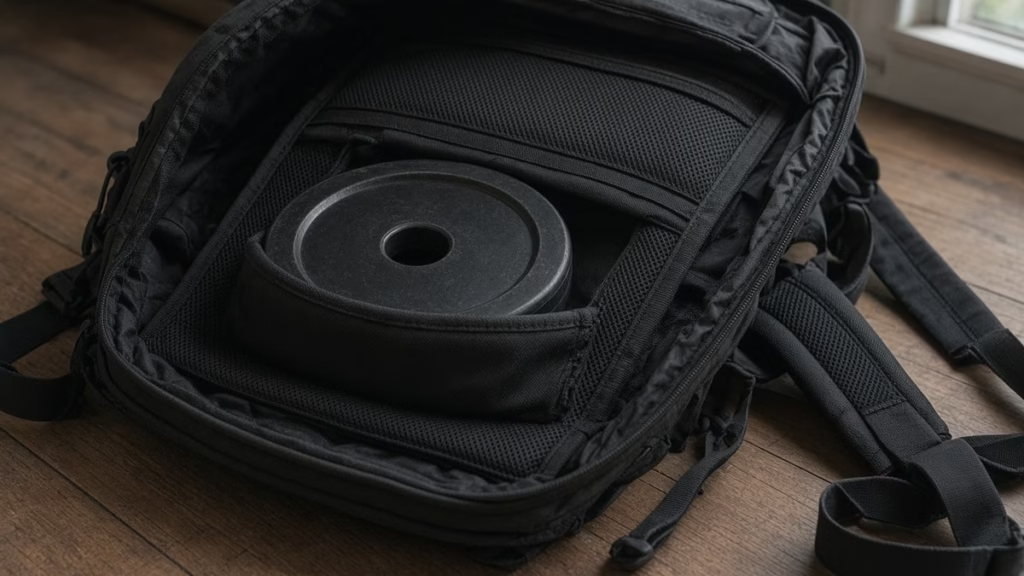
- Weight: a dedicated ruck plate, or bags of rice or books wrapped in a towel so they do not shift.
- Supportive shoes: walking shoes or trail runners you already know are comfortable.
- Water: carry a bottle for any ruck longer than 30 minutes.
- Optional: a weighted vest, which some people find more comfortable than a backpack.
FORM AND SAFETY
- Stand tall, keep your chest open and avoid leaning far forward.
- Tighten the straps so the pack does not bounce.
- Keep a normal stride; do not shorten it into a shuffle.
- Walk on lit, familiar routes and wear reflective gear at dawn and dusk.
- Check your feet after each ruck for hot spots and blisters.
- If you have back, knee or heart problems, or you are pregnant, ask your doctor before carrying extra weight.
RUCKING AND DIET FOR WEIGHT LOSS
Rucking 3 to 4 times a week burns roughly 500 to 900 calories a week for most beginners, so the diet does most of the work. Calculate your calorie deficit, aim for enough protein with our protein calculator and keep a few high-protein snacks under 200 calories ready for after longer rucks. For the general health benefits of walking, read walking benefits and good practices, and if your legs feel heavy the next day, see should you work out when sore.
FAQ
Is rucking good for weight loss?
Yes. It burns more calories than walking without a pack, mainly because it encourages longer and hillier walks, and it builds strength. Weight loss still depends on a calorie deficit.
How much weight should I ruck with as a beginner?
Start with 10 lb (4.5 kg) or 5 to 10% of your body weight, whichever is lighter, and keep it for the first 4 weeks.
How often should beginners ruck?
Two to three times a week with a rest day in between, building to 3 or 4 sessions a week after about a month.
Is rucking better than walking?
It is harder than walking at the same pace, so it burns somewhat more and builds more strength. On flat ground with a light pack, the difference in calories is small.
Can rucking hurt your back?
It can if the pack is too heavy, too loose or hangs low. Start light, keep the weight high and close to your back and progress slowly.
How long should a ruck be for weight loss?
Build to 45 to 60 minutes per session, 3 to 4 times a week, over about 8 weeks.
Can I ruck every day?
Beginners should not. Rest or walk without weight between rucks so your back, hips and feet can adapt.
THE BOTTOM LINE
Rucking is a simple way to make walking more demanding without running. Start light with 10 lb (4.5 kg), build time before weight over 8 weeks, ruck 3 to 4 times a week and pair it with a modest calorie deficit and enough protein.
Sources
- Pandolf KB, Givoni B, Goldman RF. Predicting energy expenditure with loads while standing or walking very slowly. J Appl Physiol. 1977;43(4):577-581: https://pubmed.ncbi.nlm.nih.gov/908672/
- CDC, Adult Activity: An Overview: https://www.cdc.gov/physical-activity-basics/guidelines/adults.html
- U.S. Department of Health and Human Services, Physical Activity Guidelines for Americans, 2nd edition: https://odphp.health.gov/our-work/nutrition-physical-activity/physical-activity-guidelines