



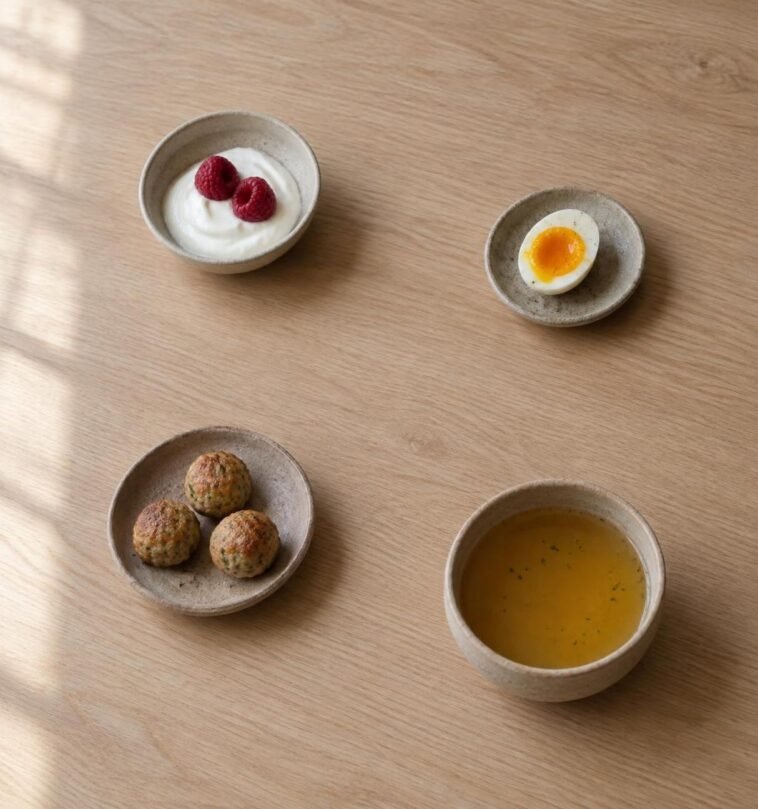
Quick answer: On a GLP-1 medication, appetite drops before your protein need does. Aim for about 1.2 to 1.6 g of protein per kilogram of body weight a day, spread over three or four small meals of 25 to 40 g each, and build every meal around the densest protein you can tolerate rather than the largest portion you can eat. For a 90 kg reference weight that is roughly 110 to 145 g a day.
This page is the hub for everything we publish on eating well when you cannot eat much. Every recipe and guide below is built to the same numbers, so you can move between them without recalculating, and the working is described in how the numbers on this site are made.
What changes on a GLP-1 medication
Semaglutide, tirzepatide and the related medicines slow how fast the stomach empties and reduce the appetite signal. Two consequences matter for food, and most diet advice ignores both.
Portions shrink faster than protein needs do. If you eat a third of what you used to, you need roughly three times the protein density per bite to hold the same daily total. This is why a plate that worked last year can leave you short of protein now.
Texture and temperature decide what you finish. Cool, soft, mild foods go down when a warm mixed plate does not. That is a practical fact about appetite, not a preference.
What that costs you if you ignore it is muscle. Losing weight quickly on too little protein means a share of the loss comes from lean tissue rather than fat, which is why protein targets get more attention on these medicines, not less.
How much protein a day, and per meal
The working range in the research is about 1.2 to 1.6 g of protein per kilogram of body weight per day while you are losing weight, spread across three or four eating occasions of 25 to 40 g. A 70 kg person lands near 85 to 110 g a day; a 90 kg person near 110 to 145 g.
Those are ranges, not prescriptions, and your clinician may set a different one, particularly with kidney disease. The two pages that work through the arithmetic in full:
- Protein target on GLP-1: how much to aim for, with the per-kilogram maths and a worked example at 90 kg.
- How to keep muscle on Ozempic, on why the target rises rather than falls while you lose weight.
If you would rather start from your own numbers than a range, the protein calculator turns your weight and goal into grams per day, and how much protein you need to lose weight explains where the range comes from.
The four rules that make food work when appetite is small
Every recipe on this page follows the same four rules. They are worth knowing because they let you improvise from your own fridge.
- Density before volume. Rank food by protein per 100 calories, not per 100 g. Shrimp, cod, egg whites, Greek yogurt, cottage cheese and canned tuna all clear 13 g of protein per 100 calories, which is roughly twice what a whole egg or a lentil gives you.
- Soft and mild beats strong and chewy. Cottage cheese, yogurt, eggs, flaked fish and soft-cooked chicken go down on a bad day. Dense dry meat does not.
- Eat on the clock, not on hunger. When the appetite signal is suppressed, waiting to feel hungry means eating twice a day by accident. Three small plates at set times beat one large one.
- Warm liquid counts. On nausea days a broth or a smoothie you can sip over twenty minutes often works when a plate does not.
The full ranking of 39 foods on all three measures, with a tool that builds a portion to your own target and calorie budget, is in the protein per 100 g and per 100 calorie chart.
What to eat when nothing sounds good
There is a specific kind of day on these medicines where food is simply unappealing. It is common, it passes, and there is a way through it that does not involve forcing a full meal.
What to eat when nothing sounds good covers the order to try things in, from the mildest option upward, and what to do if two days pass without a real meal.
Breakfast, when mornings are the hardest
Mornings are often the worst window, because the dose taken the day before is still at its strongest. These are built small, high in protein, and quick enough to make when you are not enthusiastic.
| Recipe | What it is | Why it works here |
|---|---|---|
| GLP-1 friendly protein egg bites | Baked egg bites, batch cooked | Cold from the fridge, no cooking on the day |
| Greek yogurt bowl for small appetites | Yogurt with a fruit and seed topping | About 17 g of protein per 170 g serving, no cooking |
| Copycat Starbucks egg bites | Sous-vide style egg bites | Portable, mild, reheats soft |
| High-protein smoothie for low appetite | Sippable, no chewing | The fallback when solids are too much |
| 25 high-protein breakfasts | Seasonal ideas | For weeks when you want variety |
Lunch and dinner in small portions
The trap at dinner is cooking a normal portion, eating a third, and calling it done. These are written as small plates with the protein held high relative to the portion size.
| Recipe | What it is | Numbers worth knowing |
|---|---|---|
| Gentle chicken and rice soup | Soft, mild, sippable | Built to add protein to a soup that normally has little |
| Baked lean turkey meatballs | Small portions, freezable | 30 g of protein per serving |
| Baked salmon bites with lemon yogurt | Soft fish, cool sauce | Bite-sized, so you can stop when full |
| Low-fat mild shrimp stir-fry | Mild, fast | 26 g of protein per bowl |
| Leftover rotisserie chicken, three ways | No cooking from scratch | Uses a supermarket chicken as the anchor |
| Chocolate protein mug cake | One minute, microwave | For an evening when nothing else appeals |
If you want the whole set in one place, GLP-1 friendly recipes groups them by meal, and the GLP-1 recipe category lists everything new as it publishes.
Snacks and small bites under 150 calories
Small eating occasions are where most people fall short: a snack that is only a cracker adds calories and no protein. These five each clear 9 g of protein and stay under 150 calories, which makes them the most efficient thing on the page.
- Five protein snacks under 150 calories: each takes under five minutes and clears 9 g of protein.
- Cottage cheese protein pudding: soft, cold, mildly sweet.
- Protein jello with whipped cottage cheese: for days when texture is the problem.
- Greek yogurt cheesecake: 13.4 g of protein and about 228 calories a slice.
- Edible protein cookie dough: no raw flour, no eggs.
When you can only manage liquid
Some days a plate is not going to happen. Warm, salty and sippable is the sequence that usually works, because it settles the stomach before it asks anything of it.
High-protein bone broth for nausea days has four versions that add protein to broth with gelatin, egg, chicken or tofu. A smoothie built for low appetite is the cold alternative.
A week of small meals, planned
Planning matters more here than on a normal diet, because deciding what to eat is hardest exactly when you have the least appetite. The 7-day GLP-1 friendly meal plan uses small, high-protein meals from this series across a week, and the meal prep guide covers cooking a batch once so the decision is already made.
Two tools make the week easier to hold. Recipe Lab rescales any recipe on the site to the portion you can actually finish and recalculates the protein and calories; Protein Freeze Lab builds a frozen dessert pint and shows its protein before you make it.
When to talk to your doctor
This page is general information about food, not medical advice, and nothing here is a substitute for your prescriber. Get in touch with your clinician if you cannot keep fluids down for a day, if vomiting or nausea stops you eating for more than a couple of days, if you are losing weight very fast, or if you notice strength and muscle going quickly. Those are reasons to review the plan and the dose with a professional rather than to push through with a recipe.
Questions people ask about eating on a GLP-1
How much protein should I eat on Ozempic or Wegovy?
Most guidance for weight loss lands on 1.2 to 1.6 g of protein per kilogram of body weight a day, which for a 90 kg person is roughly 110 to 145 g. Spread it over three or four meals of 25 to 40 g, because a single large meal is often impossible on these medicines.
Why do I have to eat when I am not hungry?
Because the medicine suppresses the hunger signal, not your body’s need for protein. Waiting for hunger on a GLP-1 means eating too little and too rarely, which costs muscle. Eating at set times, in small amounts, keeps the daily total reachable.
What if I can only eat a few bites at a time?
Then make those bites count: choose foods at 13 g of protein per 100 calories or better, such as cottage cheese, Greek yogurt, egg whites, shrimp, cod or canned tuna. Two or three of those small portions across the day reaches the same total as one plate you could not finish.
Are protein shakes necessary?
No. They are the least effort way to add 20 to 25 g of protein, which is why they appear often on low-appetite days, but yogurt, cottage cheese, eggs, tuna and soft fish cover the same ground. Use them when chewing is the obstacle, not as the default.
Should I eat less protein on a GLP-1 because I am eating less overall?
No, and this is the common mistake. Calories go down; the protein requirement does not come down with them. It rises as a share of what you eat, which is exactly why the density rule matters more here than on a normal diet.
Sources
Every number on this page traces back to one of these, and all of them are public:
- National Academies, Dietary Reference Intakes for Protein and Amino Acids: the official protein requirement the per-kilogram range is built on.
- Harvard T.H. Chan School of Public Health, The Nutrition Source: Protein: background on protein needs and food sources.
Where a figure here disagrees with the source, the source wins and we correct the page: the full worked method, including its limits, is on how the numbers on this site are made.